
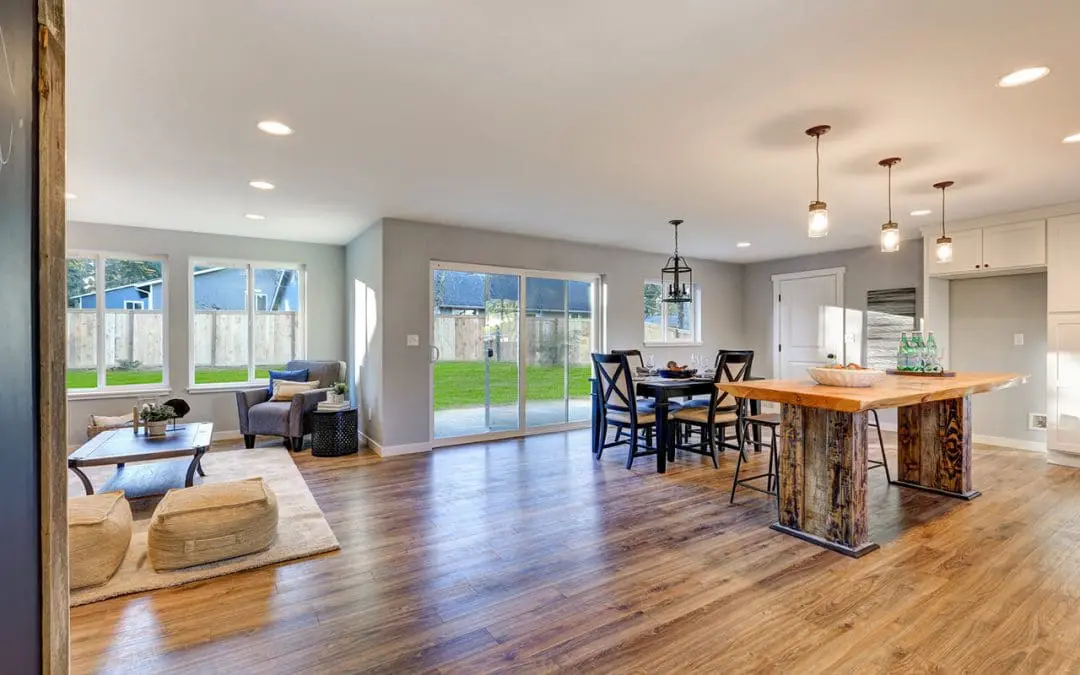
The open floor plan has dominated residential design for decades, and it remains one of the most requested features among homebuyers today. But as design trends evolve and the way people use their homes changes, more homeowners are taking a closer look at whether an open floor plan actually suits their lifestyle. The truth is that open concept living comes with real advantages and genuine drawbacks, and understanding both sides helps you make a more informed decision whether you’re buying, building, or renovating.
What Makes an Open Floor Plan So Popular
An open floor plan removes the walls that traditionally separate the kitchen, dining room, and living room, creating one large, connected living space. The space feels larger, brighter, and more socially connected than a home divided into separate rooms. Natural light flows freely without being blocked by walls, and sightlines from one end of the home to the other create a sense of expansiveness that even larger traditionally-designed homes sometimes can’t match. For families with young children, the open floor plan offers the ability to supervise kids in the living area while cooking in the kitchen without being separated by a wall. For those who love to entertain, the seamless connection between kitchen, dining, and living spaces makes hosting feel natural and inclusive rather than isolating the cook in a separate room while guests gather elsewhere.
The Real Advantages of an Open Floor Plan
Beyond the visual appeal, open floor plans offer genuine functional benefits. Flexible furniture arrangements become possible when walls aren’t dictating the boundaries of each space, a large open area can be configured and reconfigured as needs change over time. Resale value is another consistent advantage, open concept homes appeal to a broad range of buyers and tend to perform well in the market, making the design a sound investment for most homeowners. Renovation and remodeling are also easier in a home without load-bearing interior walls dividing the main living areas. Adding or updating kitchen appliances, changing the kitchen island configuration, or redesigning the dining space can all be done without major structural work. The flexibility of the layout makes it adaptable to changing lifestyles in a way that traditionally compartmentalized floor plans rarely allow.
The Drawbacks Worth Considering
For all its popularity, the open floor plan isn’t without meaningful drawbacks that are worth honest consideration. Noise is perhaps the most commonly cited challenge. Without walls to absorb and contain sound, noise from the kitchen travels freely into the living and dining areas and vice versa. For households where different family members have different schedules, sound sensitivity, or work-from-home needs, this lack of acoustic separation can become a genuine daily frustration. Privacy is another consideration that’s easy to overlook until it becomes a real issue. An open floor plan offers very little separation between activities; a teenager doing homework, a parent on a work call, and another family member watching television are all essentially sharing the same acoustic and visual space.
Temperature control and energy efficiency could also be more challenging. Heating and cooling a large, undivided space consistently requires more energy than conditioning individual rooms, and it can be difficult to maintain comfortable temperatures throughout a single large open area when different zones receive different amounts of sunlight or are used with different frequency.
Is an Open Floor Plan Right for Your Home?
The answer depends almost entirely on your lifestyle, household, and how you actually live day to day. An open floor plan works beautifully for social, entertainment-focused households with young children and a love of natural light. It works less well for households that value quiet, privacy, defined spaces for focused work, or strong acoustic separation between activities. Many newer homes and renovations are finding a middle ground, preserving the open connection between kitchen and dining while maintaining partial walls, strategically placed built-ins, or defined zones that provide some acoustic and visual separation without fully closing off the space. This hybrid approach captures the best of both worlds and may be worth considering for homeowners who are drawn to the open floor plan aesthetic but have reservations about full implementation.
Frequently Asked Questions (FAQs)
Does an open floor plan increase home value?
Generally, yes. Open concept layouts are consistently popular among buyers and tend to perform well in the resale market. However, the impact on value depends on the local market, the quality of the execution, and how well the layout suits the overall size and style of the home.
What are the biggest downsides of an open floor plan?
Noise, lack of privacy, and energy efficiency challenges are the most commonly cited drawbacks.
Can an open concept be modified to add more privacy?
Yes, many homeowners add partial walls, built-in shelving, strategic furniture placement, or room dividers to create defined zones without fully closing off the space.
Is an open floor plan better for families with children?
For families with young children, the open floor plan gives the ability to supervise kids in the living area while working in the kitchen. As children get older and need quieter spaces for homework and privacy, the lack of defined rooms can become more of a challenge than a benefit.
Legacy Property Inspections offers comprehensive home inspections in Southeast Georgia. Contact us to request an appointment for our services.